Colonialism and Animality (Routledge Advances in Critical Diversities) by Kelly Struthers Montford & Chloë Taylor
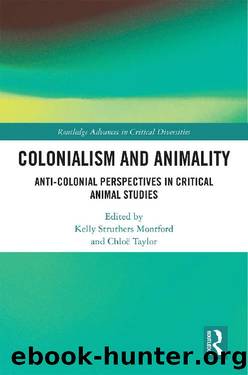
Author:Kelly Struthers Montford & Chloë Taylor [Montford, Kelly Struthers & Taylor, Chloë]
Language: eng
Format: epub, azw3
Publisher: Taylor and Francis
Published: 2020-03-01T23:00:00+00:00
Conclusions: for a contextual, relational, and ontological veganism
According to Johanna Oksala, âOntology is politics that has forgotten itself.â135 Building on a Foucauldian view of ontology as political, the previous sections have demonstrated that food ontologies are invested in power struggles. Specifically, we have argued that the dominant Western food ontology underpins the political logic of settler colonialism, while the food ontologies of alternative food movements such as carnist locavorisms are invested in a politics of purity and human supremacy, as well as political investments in ability, gender, race, and class privilege. Plumwoodâs own food ontologyâaccording to which everything living is food (although none of it is, or should be, meat)âis, we contend, also political, in so far as she collapses edibility and food, but draws lines between food and meat, in ways that reflect her political investments in environmental, animal, feminist, and Indigenous politics, as well as her particular ways of hierarchizing these agendas when they come into conflict.
Unlike Plumwood, we do not think that ontological veganism is necessarily imperialist or racist. Drawing on postcolonial critical animal studies scholars such as Maneesha Deckha, we would point out that veganism remains a marginalized diet in Western countries, and is thus far from a vehicle of Western imperialism. Western food imperialism has not spread veganism to non-Western countries or to Indigenous domestic populations; rather, it has imposed animal agriculture, animal foods, and factory farming on cultures whose diets have traditionally been plant-based, replacing relational hunting and sacred eating practices with the deaded life of animal agriculture. As Deckha writes, arguments about veganism as food imperialism
discount the enormous amounts of plant and land resources that are required to sustain current Western levels of flesh consumption and ignore the richness of non-Western flesh-free food traditions and ideologies of nonviolence toward all living beings. Indeed, these accusations align with the centuries-old majoritarian habit in Western cultures of deriding vegetarianism and, as it has come more into popular consciousness, veganism. What is different (and remarkable) today is that flesh-free diets are impugned for purported imperialist aspirations when they were denounced in the time of British empire-building as markers of anti-imperial and countercultural allegiance. Further⦠arguments that invoke multiculturalist discourse to disparage vegetarianism/veganism and otherwise sanction cruel animal practices have themselves âgone imperialâ in their disregard for animal otherness, vulnerability, and marginalization.136
Download
Colonialism and Animality (Routledge Advances in Critical Diversities) by Kelly Struthers Montford & Chloë Taylor.azw3
This site does not store any files on its server. We only index and link to content provided by other sites. Please contact the content providers to delete copyright contents if any and email us, we'll remove relevant links or contents immediately.
| Anthropology | Archaeology |
| Philosophy | Politics & Government |
| Social Sciences | Sociology |
| Women's Studies |
The Secret History by Donna Tartt(19467)
The Social Justice Warrior Handbook by Lisa De Pasquale(12293)
Thirteen Reasons Why by Jay Asher(9118)
This Is How You Lose Her by Junot Diaz(7056)
Weapons of Math Destruction by Cathy O'Neil(6466)
Zero to One by Peter Thiel(5951)
Beartown by Fredrik Backman(5931)
The Myth of the Strong Leader by Archie Brown(5623)
The Fire Next Time by James Baldwin(5581)
How Democracies Die by Steven Levitsky & Daniel Ziblatt(5322)
Promise Me, Dad by Joe Biden(5229)
Stone's Rules by Roger Stone(5186)
A Higher Loyalty: Truth, Lies, and Leadership by James Comey(5085)
100 Deadly Skills by Clint Emerson(5023)
Rise and Kill First by Ronen Bergman(4890)
Secrecy World by Jake Bernstein(4877)
The David Icke Guide to the Global Conspiracy (and how to end it) by David Icke(4849)
The Doomsday Machine by Daniel Ellsberg(4619)
The Farm by Tom Rob Smith(4611)
